Code golf
in Ruby
⛳
Before we start…
Agenda
- What is code golf?
- Out first challenge
- Magic moments
- Where to golf?
- Summary
What is the code golf?
Code golf is a discipline
in which we solve programming challenges
using the fewest characters possible.
Just like in real golf
we want to reach the goal ⛳
with as few strokes 🏌 as possible.
The most important criteria are:
- correctness
- code length (the less the better)
Our first challenge
Write a code that takes a string
and returns first word that is repeated.
Words are separated by spaces and are all lowercase.
"dom kot pies okno żyrandol pies dom szafa" -> "pies"
 ---     ----               ---- ---
Let’s start with ungolfed version.
def first_repeating_word(string)
  words = string.split
  seen = {}

  words.find do |word|
    if seen[word]
      true
    else
      seen[word] = true
      false
    end
  end
end
first_repeating_word(
  "dom kot pies okno żyrandol pies dom szafa"
) #=> "pies"
183 bytes
This is our starting point.
Let’s see how much we can shrink it!
Let’s apply golf tricks one by one.
Use single letter names for everything.
first_repeating_word -> f
string -> s
words -> a
word -> w
def f(s)
  a = s.split
  h = {}

  a.find do |w|
    if h[w]
      true
    else
      h[w] = true
      false
    end
  end
end
128 bytes
Remove unnecessary spaces.
h = {}
->
h={}
do |w|
->
do|w|
etc.
def f(s)
a=s.split
h={}
a.find do|w|
if h[w]
true
else
h[w]=true
false
end
end
end
82 bytes
Use {} blocks instead of do end.
a.find do|w|
end
->
a.find{|w|
}
def f(s)
a=s.split
h={}
a.find{|w|
if h[w]
true
else
h[w]=true
false
end
}
end
78 bytes
Do not use variables
if they are not needed.
a=s.split
a.find{|w|
->
s.split.find{|w|
def f(s)
h={}
s.split.find{|w|
if h[w]
true
else
h[w]=true
false
end
}
end
74 bytes
Use ?: ternary if operator instead of if else end.
if condition
  expression1
else
  expression2
end
->
condition ? expression1 : expression2
def f(s)
h={}
s.split.find{|w|
h[w]?true:(h[w]=true;false)
}
end
64 bytes
Use lambda -> instead of method definition.
def f(s)
end
->
f=->s{}
f=->s{
h={}
s.split.find{|w|
h[w]?true:(h[w]=true;false)
}
}
60 bytes
Remove unnecessary new lines.
Other new lines replace with ;
(just for convenience ;-))
f=->s{h={};s.split.find{|w|h[w]?true:(h[w]=true;false)}}
56 bytes
Use shorter truthy expressions than true literal.
Everything except false and nil is treated as true in conditions.
0
1
"f"
:f
{}
[]
# all are truthy
f=->s{h={};s.split.find{|w|h[w]?1:(h[w]=1;false)}}
50 bytes
Use shorter falsy expressions than false literal.
!0
!1
!"f"
!:f
!{}
![]
# all are falsy
Is there a 1 character expression which evaluates to falsy value?
p
???
Kernel#p
p(1) # prints 1, returns 1
p()  # prints nothing, returns nil
p    # prints nothing, returns nil
f=->s{h={};s.split.find{|w|h[w]?1:(h[w]=1;p)}}
46 bytes
Use _1, _2 block variables
f=->s{h={};s.split.find{h[_1]?1:(h[_1]=1;p)}}
45 bytes
Now the fun begins!
h[_1]?1:(h[_1]=1;p)
h[_1]?1:!h[_1]=1
f=->s{h={};s.split.find{h[_1]?1:!h[_1]=1}}
42 bytes
h[_1]?1:!h[_1]=1
h[_1]||!h[_1]=1
f=->s{h={};s.split.find{h[_1]||!h[_1]=1}}
41 bytes
h[_1]||!h[_1]=1
!h[_1]=!h[_1]
f=->s{h={};s.split.find{!h[_1]=!h[_1]}}
39 bytes
h={};
->s,**h{} # use ruby keyword arguments
f=->s,**h{s.split.find{!h[_1]=!h[_1]}}
38 bytes
h[_1]=!h[_1]
nil^1  #=> true
true^1 #=> false
h[_1]=h[_1]^1
h[_1]^=1
f=->s,**h{s.split.find{!h[_1]^=1}}
34 bytes
Before vs After
def first_repeating_word(string)
  words = string.split
  seen = {}

  words.find do |word|
    if seen[word]
      true
    else
      seen[word] = true
      false
    end
  end
end
f=->s,**h{s.split.find{!h[_1]^=1}}
Evolution of solutions
f=->s{h={};s.split.find{|w|h[w]?true:(h[w]=true;false)}}
f=->s{h={};s.split.find{|w|h[w]?1:(h[w]=1;false)}}
f=->s{h={};s.split.find{|w|h[w]?1:(h[w]=1;p)}}
f=->s{h={};s.split.find{h[_1]?1:(h[_1]=1;p)}}
f=->s{h={};s.split.find{h[_1]?1:!h[_1]=1}}
f=->s{h={};s.split.find{h[_1]||!h[_1]=1}}
f=->s{h={};s.split.find{!h[_1]=!h[_1]}}
f=->s,**h{s.split.find{!h[_1]=!h[_1]}}
f=->s,**h{s.split.find{!h[_1]^=1}}
Conclusions
We ended up with short and quite cryptic but functionally the same code.
Doesn’t it sound like a fun?
The alphabet
Single character strings
"a"
"?"
"ę"
?a    #=> "a"
??    #=> "?"
?ę    #=> "ę"
SIDEQUEST
Can you parse this?
(Ruby can)
?????:??
?? ? ?? : ??
"?" ? "?" : "?" #=> "?"
Array#join
[1,2,3,4].join    #=> "1234"
[1,2,3,4].join"x" #=> "1x2x3x4"
[1,2,3,4]*''      #=> "1234"
[1,2,3,4]*"x"     #=> "1x2x3x4"
[1,2,3,4]*?x #=> "1x2x3x4"
Array#uniq
a=[1,2,3,1,2]
a.uniq
a&a
a|a
a|[]
n+1, n-1
n+1
n-1
-~n
~-n
What’s the point?
m*(n+1)
m*-~n
Why it works?
~ negates (flips) all bits
5 (dec) is 0000 0101 (bin)
~5 (dec) is 1111 1010 (bin)
which is exactly -6 in two’s complement representation
-(-6) == 6 == 5+1
Operator methods
"%f"%(1.0+0.5)
"%f".%1.0+0.5
reduce:*
[1,2,3,4].reduce:* #=> 24
eval [1,2,3,4]*?* #=> 24
There are many more things like this.
Discovering them is just fun!
Magic moments
The story of one challenge
Levenshtein Distance
$ ruby solver.rb "foo fo" "bar na"
1
2
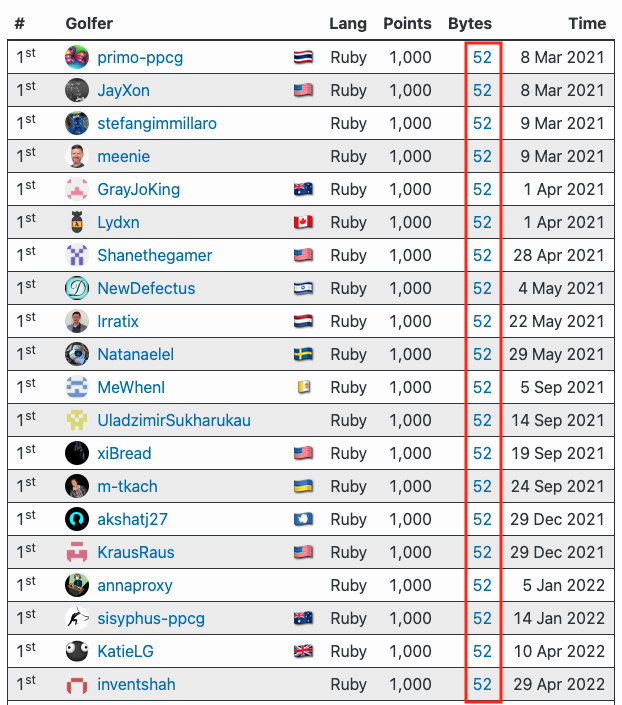
Usually means one of:
- the problem is simple to solve
- the solution is available publicly
- there is a built-in
1st and 2nd were eliminated.
Searching in the source code I found a method
DidYouMean::Levenshtein.distance("foo", "fo") #=> 1
That lead me to 52 bytes solution
$*.map{p DidYouMean::Levenshtein.distance *_1.split}
I was about to stop here but…
…I found this
$ cd ~/.rbenv/versions/3.1.0/lib/ruby
$ grep -Ri levenshtein .
(...)
./3.1.0/rubygems/text.rb:
# Vendored version of DidYouMean::Levenshtein.distance from \
the ruby/did_you_mean gem @ 1.4.0
Vendored version of DidYouMean::Levenshtein.distance
                    --------------------------------
It looked like the code in my solution
🤔
Then I checked this…
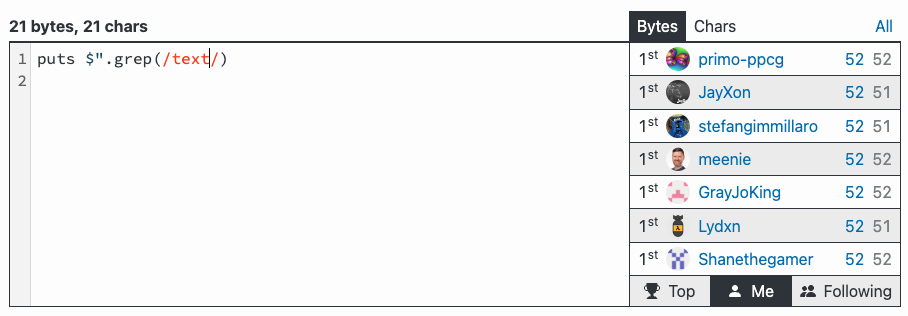

…and this
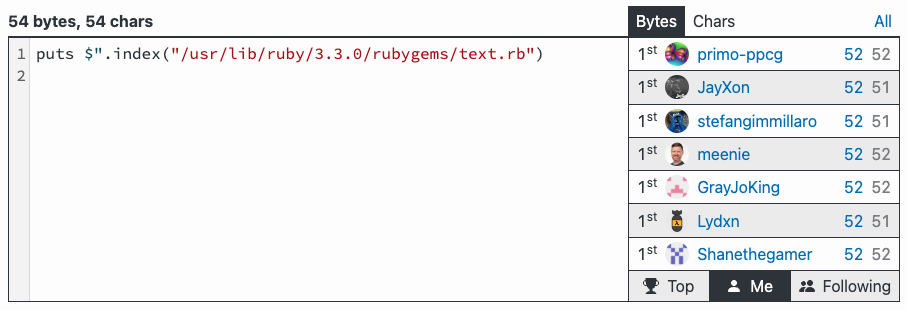

- file
rubygems/text.rbis autoloaded - path to the file is in
$"[20] - the file contains the longest part of the code
This is what I came up with
eval"$*.map{p#{IO.read$"[20],34,1280}*_1.split}"
IO.read$"[20],34,1280
" DidYouMean::Levenshtein.distance "
eval"$*.map{p DidYouMean::Levenshtein.distance *_1.split}"
😈
$*.map{p DidYouMean::Levenshtein.distance *_1.split}
52 bytes
eval"$*.map{p DidYouMean::Levenshtein.distance *_1.split}"
48 bytes
Unfortunately in the current version of rubygems the text.rb file is no longer autoloaded.
This solution doesn’t work anymore.
How to get started?
The best way is…
…to challenge your friends!
Where to golf?
- code.golf - hidden solutions, rankings, many languages
- codegolf.stackexchange.com - public solutions
- codingame.com - private clashes
- golf.shinh.org - very oldschool but many public solutions
Summary
Technically, code golf is all about shortening code.
However, to achieve this we have to explore different solutions and push language features to the limits.
At the same time, having full control over the code.
Although in a specific way, it creates great conditions for expanding knowledge about the language and its intricacies.
Thank you!
Wait!
I have 2 challenges for you
Challenge 1
Write a Ruby program that prints all numbers of regular trams in Kraków in ascending order.
Regular trams: 1 3 4 5 8 9 10 11 13 14 17 18 19 20 21 22 24 49 50 52
$ ruby tramwaje.rb
1
3
4
5
(...)
13
24
49
50
52
Challenge 2
Write a Ruby program that prints how many times the bugle call (hejnał) is played in a given time range within a 24-hour day. The bugle call is played every full hour.
$ ruby hejnal.rb 17:00 21:00
5
$ ruby hejnal.rb 17:01 21:00
4
$ ruby hejnal.rb 17:01 20:59
3
$ ruby hejnal.rb 17:01 17:40
0
$ ruby hejnal.rb 00:00 23:59
24
There are no cases like 17:00 00:00. The second time is always >= the first time.
Solutions (files) send to radek.bulat@gmail.com with title “KRUG golf #1”.
Deadline: 31.09.2024